Merrimack watershed bacteria results: July 28, 2026
The citizen scientist samplers of summer are here to bring you important information about the
upper Merrimack River watershed.
River quality monitoring results are here for your weekend plans.
Dear river and watershed friends,
The season continues (only two more dates in August left) for our sites from Franklin to Bow, comprising the Pemigewasset, Winnipesaukee, Contoocook, and Merrimack Rivers.
We know that you have heard it before but it’s important to remember that the results shown below are the probable number of E. coli colonies for every 100 millilitres (ml) of water at that moment in time. We call it a snapshot because conditions at that moment are represented and anything that happened a day or so before or after this sampling date can change drastically. All warm blooded animals (including we humans) have E. coli in their guts. That means that bacteria are an indicator that poop has found its way to the water. This could be a result of stormwater runoff, failed septic systems, mis-connected pipes that are meant to transport household waste to a treatment plant, pet or wildlife waste from river watershed, and other sources.
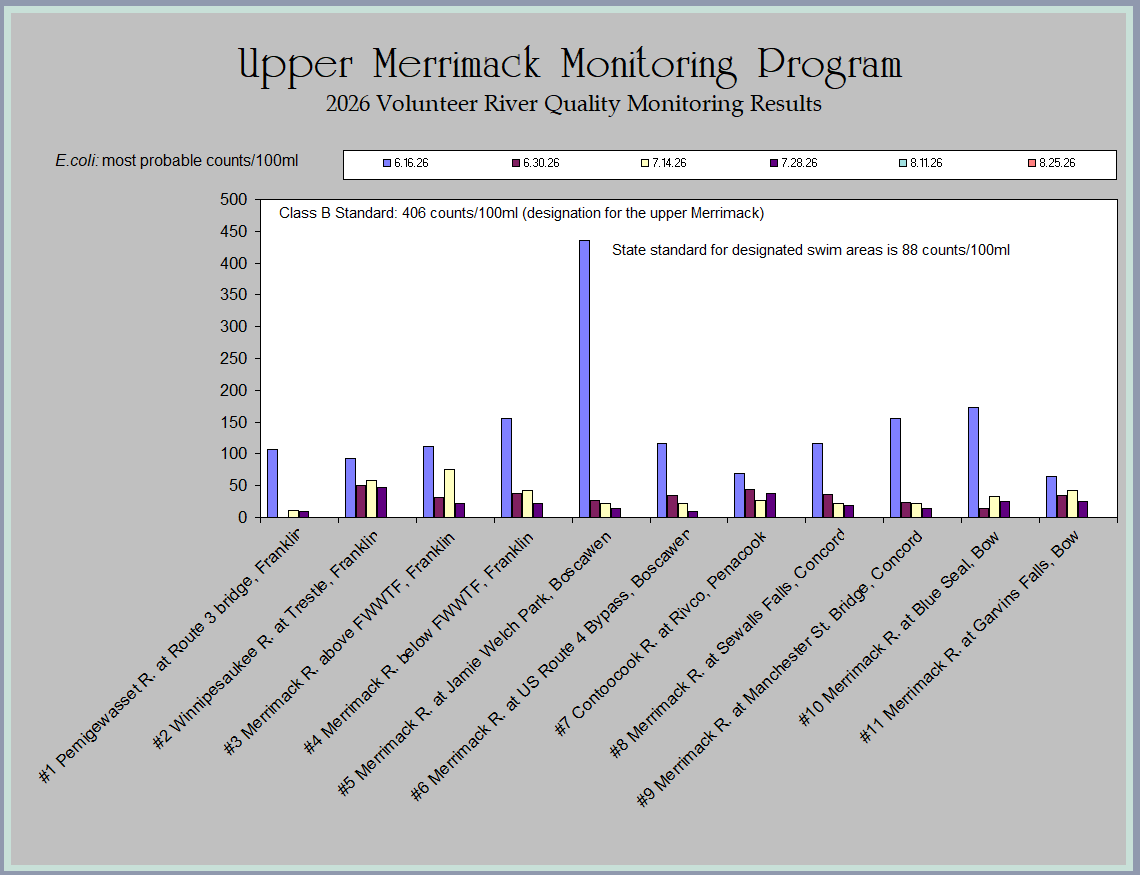
To protect public health, State of New Hampshire designated swim beaches are not allowed to exceed 88 colonies of E. coli per 100ml. Class B waters (all of our sites are designated as Class B) shall not exceed 406 colonies. These designations do not always reflect real-time water quality. The designation indicates what uses, e.g., swimming, fishing, should be supported by maintaining water quality.
This week’s analysis synopsis…
These samples were taken after a stretch of dry, sunny weather and right before the big storm on Tuesday, July 28. All of the sites met New Hampshire’s Class B standard for recreation and drinking water after treatment, as well as the standard for designated swimming beaches. Dry weather sampling is often helpful in identifying illicit connections to the river and its watershed, which might otherwise be masked by polluted rain and snowmelt runoff.
The sharp-eyed citizen scientist at Sites 9 and 10 saw something unusual: brown, flake-like material. The analysis showed an incredible diversity of organic material in the sample. See below the data table for the full list. It is not unusual to see these alga and cyanobacteria at this time of year when water is low and shallow with lots of sun to help them grow. What you are seeing in the media is the overgrowth of harmful algal growths.
You may have noticed that you have an extra jar in your sample kit. If you see something unusual, please use your extra jar to collect the sample, notify Michele at MLT@naturesource.net or call office landline at 603.796.2615, and bring your labelled sample to your drop-off location in Franklin or Concord. You are the front line of early detection for these conditions as well as invasive plants.
This trend monitoring is important but is a snapshot in time. Pollutants can be present in a river system and then clear in a day or in minutes. Leonardo da Vinci said it best, “When you put your hand in a flowing stream, you touch the last that has gone before and the first of what is still to come.”
You hear us say often, “When it rains, it’s poor,” which means that you may wish to wait a day or so after it rains before recreating in a surface water.
Here are the details.
| Site number and description | results |
| #1 Pemigewasset R. at Route 3, Franklin | 9.8 |
| #2 Winnipesaukee R. at Trestle, Franklin | 47.1 |
| #3 Merrimack R. above FWWTF, Franklin | 21.6 |
| #4 Merrimack R. below FWWTF, Franklin | 21.6 |
| #5 Merrimack at Jamie Welch, Boscawen | 13.5 |
| #6 Merrimack at US Route 4, Boscawen | 9.6 |
| #7 Contoocook R. at Rivco, Penacook | 38.4 |
| #8 Merrimack R. at Sewalls Falls, Concord | 18.7 |
| #9 Merrimack R. at Manchester St., Concord | 14.5 |
| #10 Merrimack R. at Blue Seal, Bow | 25.0 |
| #11 Merrimack R. at Garvins Falls, Bow | 25.9 |
Here is the selected list of what was found in the unusual and supplemental sample this week. Thank you to the NH Department of Environmental Services Limnology Center for their thorough and lightning fast analysis.
- Oscillatoria (cyanobacteria)- fairly common throughout sample
- Hyalotheca (desmid green)- fairly common and co-dominant with Oscillatoria
- Pseudoanabaena (cyanobacteria)- very small filaments evenly disbursed through the sample matrix, moderate density
- Fragilaria (diatom)- scattered
- Mix of pennate diatoms, various genera- fairly common
- Desmidium (desmid green)- scattered
- Eunotia (diatom)- sparse
- Mougeotia (green)- scattered in sample
- Phormidium (cyanobacteria)- sparse
- Rhabdoderma (cyanobacteria)- scattered
- Pediastraum (desmid green)- scattered
- Tetradesmus (desmid green)- sparse
- Scenedesmus (desmid green)- sparse
- Spirogyra (desmid green)- sparse
- Myxobaktron (cyanobacteria)- sparse
- Eudorina (green)- sparse
- Closterium (green)- sparse
Please join us in recognizing and thanking our Adopt-a-River Site Sponsors that make this work possible.
Aries Engineering
Elektrisola
Essex Hydro
Gideon Asen LLC
Granite Shore Power (two sites)
GZA Environmental
Watts Regulator / Webster Valve
Winnipesaukee River Basin Program (two sites)
We have two mainstem and several smaller sites available so please contact us if you are interested in becoming a site sponsor.
Our gratitude to Winnipesaukee River Basin Program for their continued support, including covering sample processing costs, taking samples, and providing a safe and convenient drop-off area. The Department of Health and Human Services Public Health Laboratory does a wonderful job processing our samples with prompt results.
A big thank you to Chantal McGuire who continues to make a major trek from her homeplace to Franklin and then to Concord to assure that samples are transported quickly and under controlled conditions.
Did you know that the Upper Merrimack Monitoring program is staffed and managed 100% by volunteers? This means that throughout the year, volunteers organize and perform activities including water sampling, collecting benthic macroinvertebrates to gauge long-term river health, and work nights in a laboratory to identify those “bugs.” If you want to learn more or get involved, please contact Michele and Steve (see below for contact information).
Volunteers will take their next samples on Tuesday, August 11, 2026.
Please visit our forum at MerrimackRiver.org/forum and the Upper Merrimack Watershed Association site MerrimackRiver.org for further information. Don’t hesitate to contact us at UMMP@MerrimackRiver.org or 603.796.2615 (landline) should you have any questions.
Sincerely,
Michele L Tremblay, Program Manager
Stephen C. Landry, Sampling Supervisor